

Key Insights:
- Delays to the CLARITY Act sale as the Senate shifts its agenda to housing policy.
- The crypto market structure bill still stands before the Banking and Agriculture panels.
- Housing costs and political elections hamper US crypto legislation.
The CLARITY Act is awaiting action in the U.S. Senate, which could delay the future of federal crypto market structure rules. The markup hearing of the bill has been delayed twice; the most recent reports indicate that the review is expected to be pushed into late February or March.
Senate Banking Committee Changes Direction to Digital Asset Law
CNBC News reported that the Senate Banking Committee has postponed its scheduled examination of the CLARITY Act market structure bill.
According to sources familiar with the issue, the committee has shifted its focus to housing legislation at the request of the Trump administration. Housing affordability issues have become a key part of the administration’s domestic economic agenda in the run-up to the November elections.
Recently, President Donald Trump has highlighted housing policy as a major domestic priority and stated that his administration is now taking urgent actions to resolve affordability challenges.
However, this new focus led the Banking Committee to put the CLARITY Act on hold, although industry stakeholders and policy advocates have continued to push it forward to achieve regulatory clarity.
The stalling has contributed to confusion over the timing of the development of the crypto market structure framework, which is meant to oversee a multi-trillion-dollar digital asset market with no single federal rulebook.
The CLARITY Act discussion is ongoing between legislators and industry players
The CLARITY Act continues to spark significant controversy among legislators, industry executives, and policy consultants.
Executive Director of the Presidential Crypto Council, Patrick Witt, has publicly called for the legislation to be enacted swiftly, saying that it is difficult to operate a large digital asset market without a detailed regulatory framework.
Coinbase CEO Brian Armstrong pulled back on his support for an earlier version of the CLARITY Act, citing specific provisions, among them what he termed an effective ban on tokenized equities.
His remarks added to the questioning of the draft bill and highlighted the challenges of balancing regulation and market innovation.
Agriculture Committee Promotes Standalone Market Structure.
Although the Senate Banking Committee has delayed its mark-up hearing, the Senate Agriculture Committee has also published its own crypto market structure bill.
Such similarity indicates the committee’s jurisdiction in some areas of the commodity and derivatives markets, including digital assets, which are classified as commodities.
Meanwhile, industry insiders have expressed concerns that the Agriculture Committee’s version of the legislation could advance as a partisan bill without Democratic support. Committee Chairman John Boozman stated that the draft builds on bipartisan discussions and incorporates stakeholder input, describing it as the result of months of work.
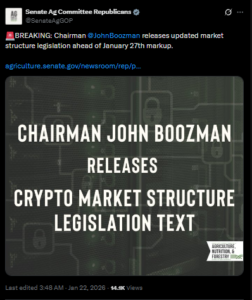
Source: Senate Ag Committee Republicans
However, Boozman also postponed the committee’s markup to late January, signaling continued procedural delays.
For the CLARITY Act committee’s market structure legislation to progress, coordination and support across both the Banking and Agriculture committees will be required.
Nonetheless, the Agriculture Committee’s bill must also secure bipartisan backing to move forward in the Senate.
The Trump Committee states an Embrace of Legislation on Crypto Market Structure
President Trump has officially indicated that he supports the CLARITY Act and more expansive laws governing the crypto market.
At the World Economic Forum in Davos in 2026, Trump stated that his administration is striving to make the United States among the global hubs of digital asset activity.
In his speech, Trump mentioned the GENIUS Act, which he had already signed into law, and stated that there is a legislative initiative in Congress on market structure.
He said he hopes to sign the crypto market structure bill soon, highlighting the administration’s stated objective of promoting digital assets within the U.S. financial system. His policy has been made a priority in the first year of the administration. Still, domestic economic issues like the cost of living and housing affordability have overridden it in recent legislative scheduling decisions.
Election timing and political dynamics drive legislative direction.
The postponement of the CLARITY Act is yet another occurrence, made on a political calculation, before the midterm elections in November.
Republicans are pursuing policy victories to offer voters, whereas recent polling and Polymarket betting suggest Democrats have a good chance of winning a House majority.
Changes in Congress may alter the course of crypto laws and overall policy interests. Consequently, the timing and legislative approach are influencing the pace and timing of the CLARITY Act’s progress in Congress.
White House crypto advisor Patrick Witt stated that the Senate should quickly pass the bill, provided negotiations continue. He noted that there may be a need to make compromises to secure enough votes to pass.