
Key Insights
- Galaxy Digital’s crypto hedge fund is a hybrid investment that combines digital assets and equities.
- The fund invests up to 30% in crypto funds and the remainder in regulated stocks.
- The institutional capital facilitates the initiation under more transparent regulations.
Galaxy Digital, the crypto hedge fund, has emerged as a Wall Street company gearing up to allocate funds to digital assets and traditional equities to address changing market dynamics and emerging regulatory contexts.
Galaxy Digital Crypto Hedge Fund Structure and Capital Allocation
According to the Financial Times, the company has already raised approximately $100 million for the fund, which is set to launch in the first quarter and will hold both long and short positions in cryptocurrencies and publicly traded stocks based on financial infrastructure.
The approach reflects Galaxy Digital’s effort to balance direct exposure to crypto tokens with investments in regulated markets that are increasingly influenced by blockchain adoption and policy clarity.
However, the company will allocate up to 30 percent of its capital to crypto assets, with the remaining 70 percent to equities in financial services and technology.
The organization is designed to restrict direct access to digital resources while remaining engaged in sectors impacted by crypto-optimal regulation and infrastructure development.
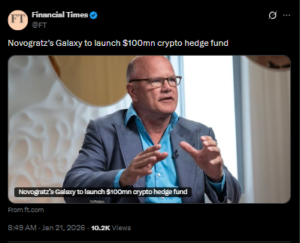
Source: Financial Times
Additionally, the Galaxy Digital crypto hedge fund is developed on a hybrid investment model. Up to 30% of the assets will be invested in crypto tokens, and the remaining assets will be invested in stocks of areas such as payments, data services, and general financial infrastructure.
Galaxy confirmed that the fund has already raised about $100 million from family offices, high-net-worth individuals, and select institutional investors. The company also said it will provide a seed investment, though it declined to disclose the amount. Additional capital may be accepted once the strategy opens, according to the report.
According to the Financial Times, the market environment is now entering a new phase, Joe Arma, who will lead the fund, told the newspaper. He stated that the earlier period of broad upward price movement has moderated, prompting a strategy that allows for both long and short positioning across asset classes.
Market Context and Asset Focus
Armao stated that major digital assets remain relevant under current macroeconomic conditions. He mentioned consistent attention to assets such as Ethereum and Solana. He stated that a decline in the U.S. Federal Reserve’s interest rates would be beneficial to Bitcoin if equities and gold prices remain unchanged.
Moreover, the launch of the fund follows volatility in the crypto market. According to CoinMarketCap, Bitcoin has also dropped almost 30% from its October highs to its current price of approximately $89,280.
Broader valuation reviews across both digital assets and traditional financial stocks have accompanied this pullback.
In addition to crypto-native firms, Galaxy is also tracking activities among select financial companies. Armao referred to sell-offs on payments and data businesses like Fiserv, stating that regulatory changes, blockchain use, and artificial intelligence are affecting valuations in the sector.
Recent Galaxy Digital Activity in Digital Assets
The Galaxy Digital crypto hedge fund is based on the company’s recent actions in the digital asset markets. In September, Galaxy acquired approximately $306 million worth of Solana, extending a broader buying program that has totaled more than $1.5 billion.
Last week, Galaxy completed its first tokenized collateralized loan obligation, Galaxy CLO 2025-1. The deal was issued on Avalanche and has financed about $75 million in loans so far. The transaction was anchored by a $50 million allocation from Grove, an institutional credit protocol within the Sky ecosystem.
The CLO supports Galaxy’s crypto lending arm by purchasing overcollateralized consumer loans backed by Bitcoin and Ether, originated by Arch Lending. The structure has the capacity to expand to $200 million. The bonds were issued and tokenized via INX, while Anchorage Digital Bank handles custody and real-time collateral tracking.
Regulatory Environment and Institutional Participation
Analysts at Bernstein Research argue that Galaxy’s position is special because it is both a crypto-native platform and an investment advisory company.
Regulatory clarity has also been cited as another factor influencing institutional activity. Analysts identified changes to the U.S. regulatory framework during the administration of President Donald Trump and to the MiCA framework of the European Union as actions that have alleviated uncertainty about the legality of market participants.
These conditions have coincided with further institutional initiatives. Morgan Stanley has announced plans to launch a crypto wallet in 2026, featuring custody and transaction services for tokenized assets.