

Key Insights:
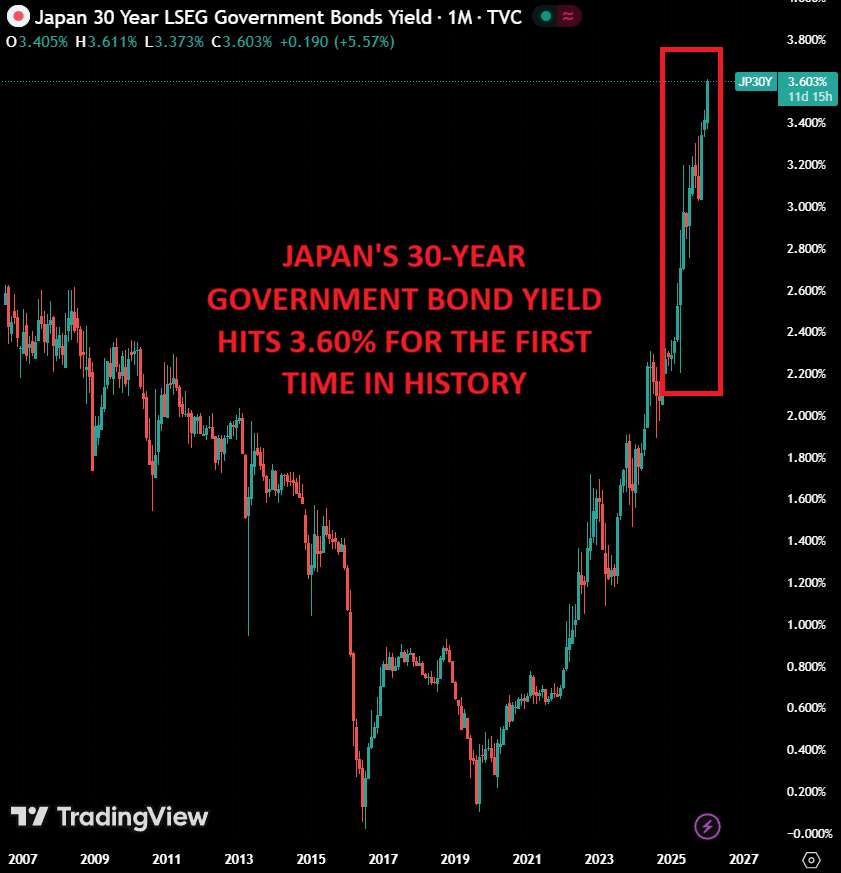
- Japanese bond yields surged to record highs for all term lengths, attracting interest from worldwide fixed-income investors.
- The increase in yields in both Japan and the United States has been a result of tighter liquidity due to trade and geopolitical tensions.
- Ethiopia has proposed a collaboration for state-supported Bitcoin mining, further integrating it into the digital asset market in Africa.
Japanese bond yields are rising sharply, but what happens when bond markets move faster than policy responses? Investors are watching record yield levels in Japan alongside trade tension signals, geopolitical messaging, and a state-backed Bitcoin mining initiative in Ethiopia.
Why Are Japanese Bond Yields Rising So Rapidly?
Japanese bond yields climbed to levels never recorded before across long-term maturities. The 30-year yield reached 3.60 %, while the 40-year yield rose to 3.94 %. Meanwhile, the 10-year yield touched 2.26 %, the highest level in 27 years.
A post shared by Global Markets Investor compared the current move to past periods of financial stress. Rapid yield increases previously pressured policymakers in the United States, the United Kingdom, and the euro area. In each case, intervention followed bond market instability.
Japan’s bond market carries global relevance due to its scale and foreign asset holdings. Japan remains one of the largest holders of U.S. Treasuries. Any sustained rise in domestic yields may shift capital flows and affect global liquidity conditions.
 Source: TradingView
Can Bond Markets Force Policy Shifts Again?
The bond market typically adjusts first, followed by the equity markets and alternative investments.
U.S. Treasury yields have increased subtly throughout January. The 10-year Treasury yield has climbed to above 4.20% with only marginal media coverage.
Higher yields will tighten the overall financial conditions by increasing the cost of borrowing and decreasing the liquidity available in the marketplace.
In previous instances, when yields rose, governments had to modify their trade or fiscal policies as market participants viewed rising yields as a real-time barometer for market stress.
With trade tensions once again emerging as a new concern, reports indicate that there are plans to implement tariffs beginning at approximately 10%, with a higher range likely in the future.
Historically, rising yields have limited the length of time these types of policies can be implemented,
How Do Geopolitical Signals Add to Market Stress?
Geopolitical rhetoric added another layer of uncertainty as bond markets faced rising pressure. A message attributed to former U.S. President Donald Trump circulated among European leaders, according to a post shared by Mario Nawfal. National security staff reportedly forwarded the message to multiple ambassadors.
In the message, Trump wrote: “Considering your country decided not to give me the Nobel Peace Prize for having stopped eight wars, I no longer feel an obligation to think purely of peace, although it will always be predominant, but can now think about what is good and proper for the United States of America.” The wording reflected a shift in tone toward national interest priorities.
The message also addressed territorial and security concerns, stating: “Denmark cannot protect that land from Russia or China… The world is not secure unless we have complete and total control of Greenland.” Such statements tend to draw market attention when they appear during periods of rising yields and tighter financial conditions.
Why Is Ethiopia Entering the Bitcoin Mining Race Now?
According to reports from Bitcoin Magazine, Ethiopia announced that it will be seeking an investment partner to create a State-Backed Bitcoin Mining Initiative during the 2026 Conference of Finance Forward Ethiopia.
Government officials confirmed that there will be state involvement in this initiative. The strategy employed by Ethiopia builds upon already existing Mining Activities that are Feasible because of the Grand Ethiopian Renaissance Dam and the Low Cost of Electricity that is produced there.
Ethiopia has 25 Licensed Miners at present, and approximately 2.5% of the Global Bitcoin Hash Rate derives from the activities of these 25 Mining Operations.
The development of this Initiative is directly aligned with the Goals of the Digital Ethiopia 2030 Strategy to create more sources of Revenue from Technological Developments.
Private Mining Operations have produced $200 Million Since Inception, placing Ethiopia as a Key Player in the Development and Evolution of the Digital Asset Space Globally.
Final Thoughts
With Japanese bond yields recently reaching historical highs, there has been an increase in interest from international investors toward Japan.
Increasing trade and political tensions, as well as the announcement of Bitcoin mining by the Ethiopian government, have contributed to increased interest in the growing digital asset market.
Over the course of the next several weeks, financial markets worldwide will be focused on how the movement of Japanese bonds, changes in monetary policy, and developments in cryptocurrency affect the market.