

Key Insights:
- Strategic Bitcoin Reserve order challenged following the transfer of confiscated bitcoin to Coinbase Prime.
- Arkham data indicates $ 6.36 million in bitcoin transferred from a USMS wallet to Coinbase Prime.
- Justice Department and White House review possible breach of Executive Order 14233.
Strategic Bitcoin Reserve Faces Scrutiny After Seized BTC Transfer
U.S. Senator Cynthia Lummis said she was “deeply concerned” after reports indicated that Bitcoin seized in a federal criminal case may have been sold despite a presidential directive requiring such assets to be preserved for a planned Strategic Bitcoin Reserve.
The issue centres on Bitcoin forfeited through a Justice Department settlement that appears to have been transferred to a Coinbase Prime account and no longer remains in government custody, raising questions about compliance with an executive order signed by President Donald Trump.
https://twitter.com/SenLummis/status/2008356529141956965
The remarks by Lummis came after it was reported that federal authorities could have forfeited and sold the Bitcoin as a result of forfeiture, even though Executive Order 14233 stated that the seized Bitcoin should be stored as part of the Strategic Bitcoin Reserve.
Executive Order Requirements and Strategic Bitcoin Reserve.
Executive Order 14233 created the Strategic Bitcoin Reserve and requires the federal government to retain Bitcoin obtained through criminal or civil asset forfeiture proceedings.
The order states that agency heads “shall not sell or otherwise dispose of any Government Digital Assets” unless approval is granted through a formal process.
Senator Lummis stated that the reported sale involved approximately $6.3 million in Bitcoin. According to her office, the alleged liquidation occurred despite the executive order’s requirement that such assets be preserved.
Lummis stated that the issue raises concerns about whether federal agencies are following the president’s directive regarding the Strategic Bitcoin Reserve.
The executive order applies broadly to Bitcoin obtained through forfeiture and places restrictions on agency discretion. Any disposal of seized digital assets must be justified and approved at the highest levels, as stated in the order.
The move occurred after legal actions in the Samourai Wallet case.
Blockchain intelligence platform Arkham reported that defendants Keonne Rodriguez and William Lonergan Hill transferred approximately $6.36 million in Bitcoin to a U.S. Marshals Service (USMS) wallet, identified as address 3Lz5U, on November 3, 2025.
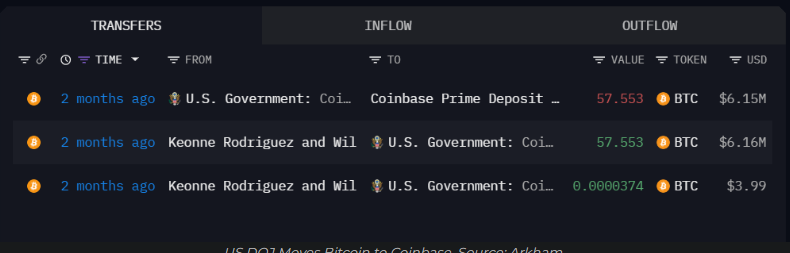 Source: Arham
Arkham records also suggest that bitcoin transferred through the address bc1q4 did not stay in the actual possession of the USMS. Rather, the money was subsequently transferred from the wallet bearing the 3Lz5U address to a different address, which was named Coinbase Prime Deposit and identified by the address 1AaFQ.
Arkham claims that this talk is given by Coinbase Prime, which is an institutional trading platform.
The Coinbase Prime Deposit address had a zero balance at the time of reporting. The fact that there is no money in that wallet has been taken to mean that the Bitcoin was probably sold after the transfer.
Federal agencies have not publicly confirmed whether the assets were liquidated or whether any approvals were granted under the executive order.
Justice Department Case Background
The Bitcoin in question was forfeited as part of a criminal case involving Samourai Wallet, a cryptocurrency mixing service. Rodriguez, who served as chief executive officer, and Hill, the company’s chief technology officer, were accused of operating a service that prosecutors said facilitated illicit financial activity.
Additionally, court records stated that Samourai Wallet was charged with laundering over $237 million between 2015 and 2024.
Prosecutors have argued that deals conducted with the help of the service were related to such crimes as fraud, darknet markets, cybercrime, and murder-for-hire operations.
Acting U.S. Attorney Nicolas Roos stated at the time that the defendants “created and operated a cryptocurrency mixing service that they knew enabled criminals to wash millions in dirty money.”
As part of their plea agreements, Rodriguez and Hill agreed to forfeit assets related to the crimes, including Bitcoin worth approximately $ 6.37 million, or 57.55 BTC, at the time of the transfer.
Strategic Bitcoin Reserve Compliance Questions
The reported handling of the Samurai Wallet Bitcoin has prompted questions about whether the Justice Department has authorized or conducted other Bitcoin liquidations under similar circumstances. Lummis said that selling seized Bitcoin could conflict with building the Strategic Bitcoin Reserve.
The issue has drawn attention because the Samourai case originated under a prior administration that pursued enforcement actions against privacy-focused crypto tools.
In April 2025, Deputy Attorney General Todd Blanche issued a memo stating that the Justice Department “will no longer target virtual currency exchanges, mixing and tumbling services, and offline wallets for the acts of their end users.”
Despite that policy shift, the forfeiture and subsequent handling of the Bitcoin remain subject to the requirements of Executive Order 14233.
Administration Response and Ongoing Review
Patrick Witt, Executive Director of the President’s Council of Advisors for Digital Assets, confirmed that the Trump administration is reviewing whether the reported Bitcoin transfer violated the executive order governing the Strategic Bitcoin Reserve. Witt said the matter is under investigation, but did not provide additional details.
Federal officials have not formally addressed whether the transfer to Coinbase Prime constituted a sale or whether any exception under the executive order was applied. No public statements have been issued by the Department of Justice or the Treasury Department clarifying the status of the forfeited Bitcoin.