Key Insights:
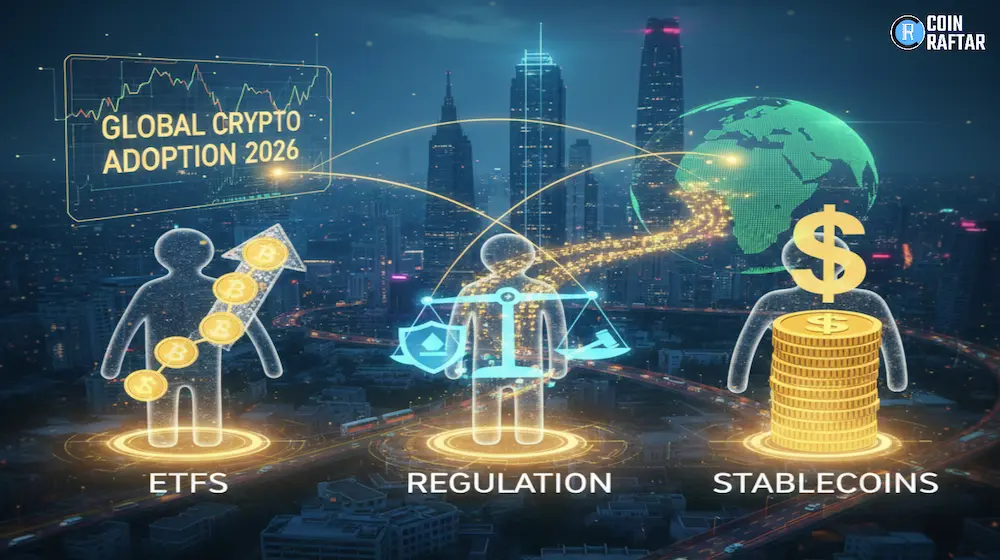
- Cryptocurrency adoption in 2026 is growing steadily, supported by ETFs and regulation.
- Cryptocurrencies and tokenization are being integrated into settlement operations through control systems.
- Policy debates on stablecoin rewards shape competition between US frameworks and China’s digital yuan.
Crypto Adoption 2026: ETFs, Stablecoins, and Regulation Drive Next Phase
Crypto adoption in 2026 is poised to continue the structural shifts that gained momentum over the past year, as exchange-traded funds, stablecoins, tokenization initiatives, and regulatory frameworks begin to reinforce one another.
According to statements from Coinbase executives, developments in 2025 marked a transition from experimental growth to operational integration, setting the stage for wider institutional and transactional use in the year ahead.
In a year-end outlook shared publicly, Coinbase’s head of investment research, David Duong, said the digital asset market entered a new phase in 2025.
Further, Duong has also said that the ETF approval process is shortening, and that stablecoins are being set up to resolve in a delivery-versus-payment structure.
According to Duong, these changes reflect institutional integration rather than short-term market cycles, setting conditions that could drive broader participation in 2026.
Crypto Adoption in 2026 and the Role of Market Infrastructure
Duong stated that the forces supporting crypto adoption in 2026 are expected to intensify as ETF approval processes become more streamlined and market infrastructure matures.
In his assessment, stablecoins are increasingly being positioned for delivery-versus-payment arrangements, while tokenized collateral is gaining wider acceptance in conventional financial transactions.
https://twitter.com/DavidDuong/status/2006381532756295969
Additionally, he noted that tokenized collateral is increasingly being recognized as part of the broader set of traditional financial transactions, meaning it is not limited to pilot programs.
According to analytics provider Demand Sage data, the global use of crypto has remained within a very narrow range over the past two years, with the value fluctuating between 10.3 in the first quarter of 2023 and 9.9 in the first quarter of 2025.
This stability, according to Duong, indicates a market that is approaching a more mature stage, where an increase in utilization is in line with the regulatory and institutional readiness.
During the 2025 period, various large jurisdictions developed formal oversight models, which made more sense in describing the issuance, custody, and utilization of digital assets.
These interventions have impacted the way financial institutions evaluate risks and capitalize in crypto-related products.
Institutional Readiness is affected by Regulatory Frameworks.
In the US, legislators proceeded with the legislation of stablecoins in the form of the GENIUS Act, introducing more specific regulations of dollar-pegged tokens and payment-oriented applications.
According to Duong, such developments have led to what he terms operational readiness, enabling companies to create products and incorporate crypto rails into payment and settlement systems.
Additionally, a parallel debate has emerged over whether restrictions on stablecoin rewards could influence global usage patterns.
Stablecoin Policy and Global Competition
Adding to the discussion, Coinbase’s chief policy officer, Faryar Shirzad, warned that the United States could lose ground in global digital currency adoption if it strictly enforces prohibitions on interest or rewards for U.S.-issued stablecoins. His comments followed announcements from China indicating changes to the design of its digital currency.
Shirzad stated that the competition among countries over digital money has intensified, with incentives such as rewards or interest potentially influencing user and business preferences.
He noted that if U.S. dollar-backed stablecoins are prevented from offering such features, users may gravitate toward foreign-issued stablecoins or central bank digital currencies.
Coinbase has stated that the GENIUS Act was intended to position regulated, dollar-backed stablecoins as leading tools for global digital payments.
According to Shirzad, broad restrictions on rewards could undermine that objective and weaken the international role of the U.S. dollar in digital finance.
China’s Digital Yuan Introduces Interest Payments
Building more on this sentiment, China’s central bank has announced that beginning January 1, 2026, banks will be permitted to pay interest on balances held in the digital yuan. This policy shift changes the digital yuan from functioning solely as a cash-like instrument to operating more like an interest-bearing deposit.
https://twitter.com/faryarshirzad/status/2006056639049191915
Chinese officials have indicated that the move will focus on improving usage, which has been low following a few years of pilot programs.
The capability to generate interest can be used to enable the digital yuan to compete with traditional bank accounts and privately owned payment systems. It will also increase the appeal in international transactions, particularly in regions with financial ties to China.