Key Insights
- Approval governance, since its inception in the treasury, Uniswap tokens’ burn has decreased the UNI amount by 100 million.
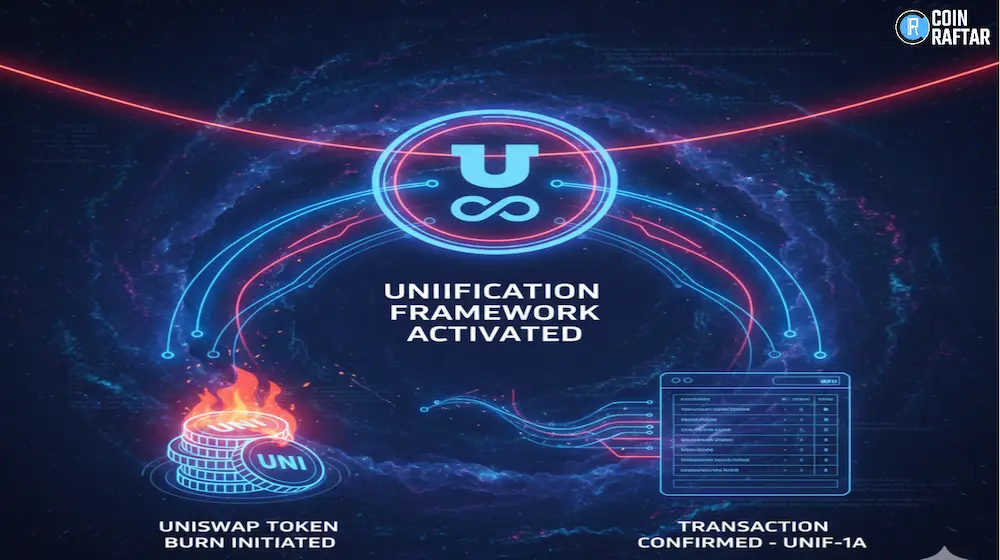
- UNIFication is activated, and part of the trading proceeds is deposited into UNI burns.
- Circulating UNI supply fell while trading volume and market cap increased
Uniswap token burn removes 100 million UNI following governance vote
The Uniswap token burn was executed on December 28, marking the first large-scale implementation of the protocol’s long-anticipated fee-burning framework, known as UNIfication.
On-chain data confirms that approximately 100 million UNI tokens were permanently removed from Uniswap’s treasury at around 4:30 a.m. UTC, according to blockchain analyst EmberCN. At prevailing market prices at the time of execution, the burned tokens were valued at roughly $596 million.
The on-chain transaction was confirmed by blockchain analyst EmberCN, as the burn was executed following a governance vote that was finalized earlier in the week.
The move had a direct impact on decreasing the supply of tokens in Uniswap, and formalized a long-awaited change to the treatment of protocol revenue.
The move came after governance participants approved the proposal known as “UNIfication,” which enables protocol-level fee collection and directs a portion of those fees toward systematic UNI burns.
Governance vote delivers near-unanimous approval.
The UNification proposal passed on Thursday with 99.9% support, according to governance records. More than 125 million UNI tokens were cast in favor of the proposal, while only 742 UNI were recorded as votes against.
Moreover, several individuals with significant governance influence supported the measure. They were Jesse Waldren, managing partner and founder of Variant; Kain Warwick, founder of Infinex and Synthetix; and Ian Lapham, formerly an engineer at Uniswap Labs.
Their involvement added to the voting power backing the proposal, but did not alter its governance pattern, which remained under the on-chain voting regulations.
Uniswap Labs later confirmed that the proposal, which has been implemented, stating in an X post that “UNIfication has officially been executed on-chain.”
https://twitter.com/EmberCN/status/2005072023362666511
Uniswap token burn tied to protocol fee activation.
The Uniswap token burn is directly linked to the activation of the protocol fee switch, a mechanism that has been discussed within the Uniswap ecosystem for several years.
Under the new structure, a portion of the trading fees generated on certain protocol deployments will be routed to the protocol, rather than being distributed entirely to liquidity providers.
As part of the initial rollout, Uniswap Labs’ interface fees were set to zero. At the same time, protocol fees were activated on Uniswap v2 and selected Uniswap v3 pools on the Ethereum mainnet. Additionally, fees generated on Unichain will contribute to UNI burns, after accounting for Optimism network costs and Layer-1 data expenses.
However, Ethereum remains the primary settlement layer for the pools affected in the initial phase of the fee switch.
Supply impact and market data following the burn
Following confirmation of the burn, UNI rose by more than 5% over 24 hours, according to market data. Trading volume and market capitalization both increased during the same window.
According to CoinMarketCap, UNI’s circulating supply now stands at approximately 730 million tokens, compared with a fixed total supply of 1 billion UNI.
The transaction does not affect existing holder balances but alters the long-term supply curve associated with protocol activity.
Foundation funding and growth budget plans
When the proposal was introduced, the Uniswap Foundation stated that developer funding would continue alongside the new fee structure. According to the Foundation, grant programs supporting protocol builders are not being discontinued.
To promote further growth, the Foundation will establish a Growth Budget comprising 20 million UNI tokens. The budget is structured as a recurring allocation, as opposed to a single incentive program.
Governance structure and authority
Unification is another system that cleanses operational tasks of the Uniswap ecosystem. Under the new structure, foundation teams and functions have been shifted to UniSwap Labs, whereas the Labs’ interface, wallet, and API fees have been eliminated.
Additionally, a new legal structure based on Wyoming’s Decentralized Unincorporated Nonprofit Association (DUNA) framework aligns Uniswap Labs, the Foundation, and on-chain governance under a single entity.