Key Insights:
- The Bank of Japan increased its benchmark interest rate to 0.75 percent, the highest rate hike level in three decades.
- In the past, Bitcoin fell 25–26 percent following past BOJ hikes, a sign of the high sensitivity of cryptocurrencies to changes in Japan’s monetary policy.
- Yen carry trade effects have diminished, and investors are using diverse funding instruments to reduce risks while maintaining measured responses to rate changes.
The Bank of Japan (BOJ) has officially announced a 0.75 percent interest rate hike. This has marked a three-decade high after a two-day policy meeting. This increase is the first rate hike under Prime Minister Sanae Takaichi and is part of Japan’s broader ongoing monetary normalization efforts. Market investors have adjusted their positions in response to the higher rates amid global economic concerns.
BOJ Ends Negative Rates as Inflation Persists
The central bank of Japan raised the benchmark rate by 25 basis points. Earlier on, prior hikes were in July 2024 and January 2025. This step continues Japan’s gradual exit from negative interest rates. There is a continued effort to balance growth metrics with rising inflation pressures.
Since Takaichi assumed office, the yen has weakened sharply against major currencies. Traders are very concerned that the expansionary fiscal policies may exacerbate Japan’s debt levels. Notably, yields on newly issued 10-year government bonds approached 2 percent, a signal of higher long-term rates.
Market participants have noted that persistent inflation and negative real interest rates will be key drivers.
Bitcoin Volatility Mirrors BOJ Rate Cut Decisions
Bitcoin fell 24 percent in the 2024 hike. This was a clear indication of how the crypto market is sensitive to Japan’s interest rate changes. Additionally, this reduced liquidity and cautious investor behaviour have triggered a temporary pullback in risk assets.
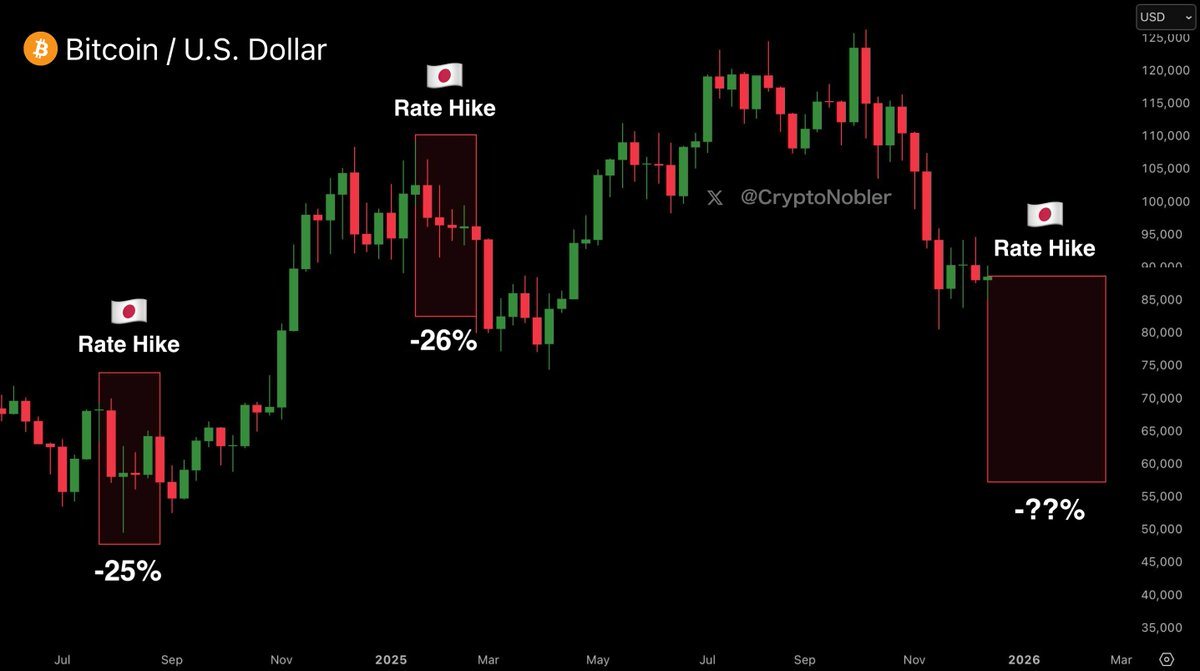
Bitcoin/USDT BOJ Hike Rate Reaction | Source: X
The second rate hike in 2025 caused Bitcoin to decline roughly 26 percent, which was very similar to the previous reaction. This shows that market participants had not fully positioned themselves. In prior hikes, global sentiment and inflation expectations influenced investor behavior greatly.
In addition, market adjustments, US Federal Reserve policy, and broader economic factors could greatly influence the cryptocurrency’s response. Past trends suggest that Bitcoin may face further downside pressure.
Yen Carry Trade and Market Stability
Analysts, including Ankita Pathak, indicated that the pace of BOJ hikes remains well calibrated. They noted that despite a total increase of 50 basis points this year, the real interest rate is still negative at around 2.2 percent. Therefore, this balance may support economic growth while curbing inflation.
The current Yen carry trades are less impactful than in previous decades. Investors are increasingly using diverse funding sources such as dollars, euros, and derivatives. This shows that yen’s role in global funding structures has diminished, and this has made sudden carry unwind risks lower.
Market behavior shows that there is a measured responses to the rate hikes. Yen movements have remained sensitive to policy, but global shocks appear to be contained. Investors are keenly monitoring Japan’s decisions to determine the broader upcoming market signals.